ChemEng stuff followers

Showing posts with label safety. Show all posts

Wednesday, November 20, 2024

About the contactor

 For short, a contactor is an encapsulated relay on steroids.

Just as the encapsulated relay, a contactor has:

  • a coil,
  • a set of contacts and
  • a test button.

However, a contactor is built for heavy duty applications.


You can read about the encapsulated relay here: About the encapsulated relay.

Knowing the contactor

A contactor should be easy to identify. You should see coil terminals, auxiliary contacts (NO or NC or a combination of these), power contacts and a small level working as a test button. Depending on the manufacturer and model, these features can be arranged in different ways.

Most models are design for rail mounting inside a cabinet. However, more expensive models may have other features such as small pilot lights or self-coupling to other components such as overload relays, to say an example.

Images of sample contactors


The coil

The contactor coil can be easily identified by the A1 and A2 terminals. You should  remember that depending on the model, the coil may be for DC or AC and design for a given voltage too.

In the contactor, the coil does the same work as the encapsulated relay: when it is energized a set of contacts is open or closed.

The contacts

In the contactor, two types of contacts appear,

  • auxiliary contacts and
  • power contacts.

Auxiliary contacts are meant for turning on/of devices of low voltage such as: pilot lights or alarms, for example. On the other hand, power contacts are used for powering equipment requiring high voltaje and representing a potential danger for an operator, such as: motors or electrical resistances, to name some.

In a contactor, the number of contacts are,obviously, specified according to the application of the component. It is common practice that auxiliary contacts are NO but one NO and one NC or only NC contacts can be looked for. You can identify the auxiliary contacts in the contactor by NO or NC legend.

Contacts in a contactor. Manufacturer: WEG, Model: CWB9


On the other hand, power contacts are always NO since these are meant for energizing an equipment. You can identify the power contacts by the letters L1, L2, etc. and T1, T2, etc.. The letters L and T stand for: line and terminal; while the numbers indicate correspondence between each terminal, this is: L1 and T1 are a NO contact, and so on. Also, all NO power contacts are independent so that L1 and T2 do not form a contact.

Specification of a contactor

Specifying a contactor is usually reduced to determine the number of NO/NC auxiliary and NO power contacts. Therefore, you should, first, determine what is to be turn on/off by the auxiliary contacts so that a ladder diagram needs to be well established before anything else.

The power contacts are related to the power diagram or circuit. You need to know if the equipment is single or triple phase or something else so that the number of poles (NO contacts) can be determined.

Rating

Contactor rating usually refers to the NO power contacts since these are the ones to be subjected to high voltage and current. These contacts need to be such that can withstand a given maximum voltage and current intensity.

Again, you need to know the electrical features of the equipment to plug into the contactor so that you can safely use the proper option.

Sometimes, rating is also related to the selection of the coil. However, the coil is selected according to ladder diagram and features of other components in the same circuit.

Any question? Write in the comments and I shall try to help.

Other stuff of interest

Saturday, February 24, 2024

About the encapsulated relay

 An encapsulated relay is a device used for closing NO contacts or openning NC contacts. These NO or NC contacts can be used for auxiliar or power purposes.

On application of the encapsulated relays is for electric isolation between two circuits. One of these can be potentially dangerous (high voltage) while the other one could be safer for operators (low voltage).

Other applications for encapsulated relays are known, such as: interfacing between actutators and controlling devices, etc.

How does an encapsulated relay looks like?

Well it depends on the model you are referring to. For example you may find some like those sell by ABB,

Fig. 01 ABB encapsulated relays.

Among the features that make these kind of relays we may list,

  • different number of contacts NO/NC are available. You may have one contact only or four or more,
  • there are options for soldering on pcb,
  • other models are suitable for reduce space installation in control panels,
  • other models are design to resist vibrations.
However, one feature all relays in Fig. 01 share is that these can be mounted on rail DIN.

The encapsulated relays are usually made of two parts. The relay module and the socket. The socket is the accesory that allows the relay module to be firmly mounted to the rail DIN.
Fig. 02 Here is an image of an encapsulted relay showing the pins (bottom metal sticks)

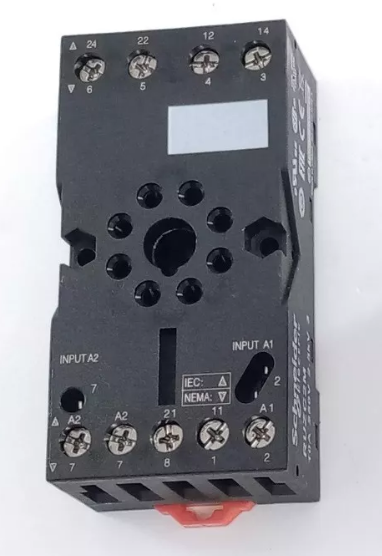
Fig. 03 Socket of an encapsulated relay. Notice that the terminals are numbered and are related to the pin and diagram of the encapsulated relay. These may change from one manufacturer to other.


How does an encapsulated relay work?

In order to give a more precise explanation we should refer to the diagram of an encapsulated relay. Take for instance the one shown below,
Fig. 04 Diagram of and 8-pin encapsulated relay. Numbers in parenthesis are related to the pin of the relay while numbers without parenthesis are related to contact numbers in the socket (see Fig. 03).

Contacts are formed with the terminals available. For example, in Fig. 03 terminals 24 and 21 are a normally open contact NO while 21 and 22 make a normally closed contact NC. As you can see, the encapsulated relay in Fig. 04 has two NO contacts and two NC contacts.

Terminals A1 and A2 are devoted to the coil of the relay. As electricity passes through it the coil is energized and an electromagnet is formed. As the electromagnet is formed the contacts change their position. This is, the NC contacts open and the NO contacts close.

Then, you may use low voltage to operate the relay coil and the contacts for higher voltage so that you are using the encapsulated relay to isolate two different circuits. This is why this device can be considered for safety when designing a control loop.


Wednesday, January 17, 2024

A list of questions to ask to identify personal safety hazards

 Take this post as a tool to perform a formal risk assessment.

There are 5 common categories of hazards to be known. Here a brief explanation and a short list of questions that may be helpful to get a more complete risk matrix.


Fig. 01 A map of the safety hazards


Biological hazards

These are related to other subcategories such as:

  • biological contamination and
  • infection due to hazardous organisms,
for example. Some materials to be processed in a plant are always contaminated (like waste materials) or should nod be contaminated (as in food industry).

Some questions you may ask are and so use the answers to find solutions are as follows:
  • is the personnel going to work near waste materials? (for example in a waste water treatment plant)
  • is the personnel going to handle sharp objects or dusty materials? (for example in a solid waste recylcing plant)
  • is the work environment be fill with volatiles compounds or dust from waste? (for example in a solid waste recylcing plant)
  • would you recommend the use of gloves, safety goggles or face masks inside the plant?


Physical/mechanical

These are commonly related to accidents such as:

  • slips,
  • cuts,
  • falls,
  • noise,
  • burns,
  • falling objects,
  • vehicles in motion,
  • automated machines moving,
  • repetitive motions (fatigue) and
  • heat/cold/dehydration/stress strikes
for example. These kind of risk are commonly due to excess of confidence by the personnel during activities in hazardous zones.

Some questions to ask to reduce the risk may be:
  • may a leak or spill of liquids cause slipery floor? (these may occur in oil re-processing/re-refining operations),
  • should the personnel need to be close to a machine or vehicle whose motion be a danger? (as in a manufacturing or assembling line),
  • will the personnel handle sharp objects (pices of metal, broken glass, etc.)? (as in a waste recycling facility),
  • is there any equipment that should operate at high temperatures near the personnel? (such as boilers)
  • is there any equipment having risk of explosion? (such as boilers or pressurized vessels)

Chemical

These risks are common to operations involving chemicals, its reactions and products/subproducts. Gases, dust or liquids comming from chemical processes may be toxic. These risks are usually referred as: chemical intoxication.

Some sample questions to help are as follows:
  • may the chemical reaction release toxic vapors?
  • what is the phase of the toxic compounds/materials? (liquid, gas, solid, two-phase)
  • what is the level of toxicity of the materials used in the process?
  • what is the type of protection needed for the personnel?
  • is there characteristic smell/odor for the toxic gasses?
  • shall sensor-alarm system be needed?

Electrical

These are also related to accidents. These risks perhaps can be named as: short-circuit risks. Some potential causes are:

  • static electricity,
  • overload in drives, and
  • magnetic fields.
for example. Electric motors are very common in industry and poor maintenance may cause failures and potential risks to the operators. Operations where dust is present may cause strong electric discharges to personnel.

Some questions you may ask are:
  • what unit operations of the process generate dust?
  • is there any dust collector?
  • is there proper ground installed in the plant?
  • is the control cabinets assembled with proper electrical protection? (fuse, overload relays, etc.)


Psychosocial

These risk are related most of the time to the design of the plant where the personnel spend most of the day. Examples of these may be,

  • dinning room near to noisy operation zones,
  • poor personnel training,
  • poor management of the plant, and
  • confined spaces
for example. Some sample questions are:
  • is the meals/rest time enough,
  • what is the relationship between operators and supervisors?,
  • are the bathrooms located at convienent distance from the personnel?
  • is the illumination according with the spaces and time of the day?


Most popular posts